Research Overview
Our research group focuses on developing innovative data-driven and physical-based models to advance drug discovery and synthesis, particularly for natural products. We combine computational approaches with biological insights to address key challenges in pharmaceutical research, from molecular design to biosynthetic pathway optimization.
Research Areas
Cheminformatics & Database Development
We develop comprehensive databases and computational tools for natural products research. Our work includes chemical space analysis, structure-activity relationship studies, and the creation of specialized databases like TeroKit for terpenome research. We focus on exploring the vast chemical diversity of natural compounds and developing methods to navigate and analyze complex chemical spaces.
Key Techniques:
- Natural products database development
- Chemical space analysis and visualization
- Chemotaxonomic investigation methods
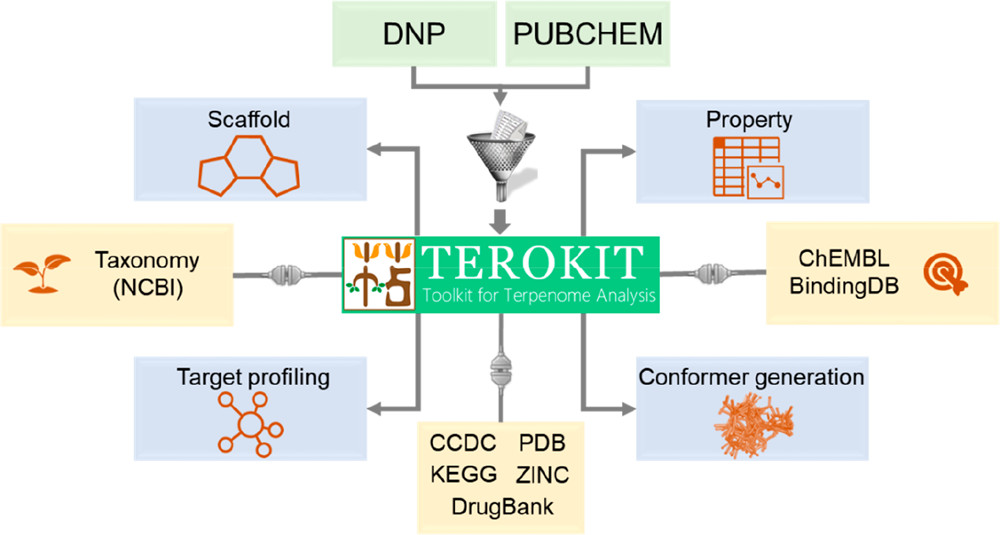
The picture is from the article: TeroKit: A Database-Driven Web Server for Terpenome Research
Drug Design & Molecular Generation
Our research in drug design combines AI and machine learning approaches with traditional computational chemistry methods. We develop predictive models for molecular properties, design new therapeutic compounds, and use quantitative structure-activity relationship (QSAR) modeling to optimize drug candidates. Our focus includes both small molecule drugs and natural product-inspired therapeutics.
Key Techniques:
- Molecular generation using deep learning
- Quantitative structure-activity modeling
- Data-driven prediction of molecular properties
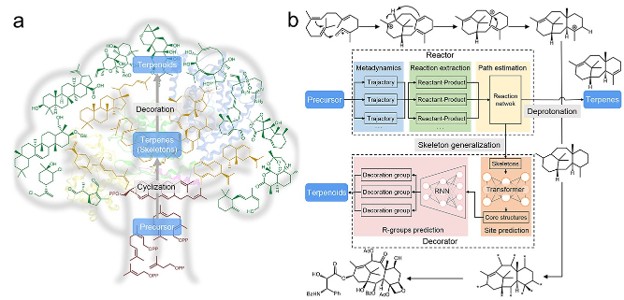
The picture is from the article:Bio-inspired Chemical Space Exploration of Terpenoids
Synthetic Biology & Enzyme Design
We develop computational approaches for synthetic biology applications, focusing on bio-retrosynthesis planning and enzyme design. Our work includes the development of BioNavi and BioNavi-NP platforms for planning biosynthetic pathways, molecular dynamics simulations for enzyme optimization, and the design of sustainable production routes for complex natural products using biological systems.
Key Techniques:
- Bio-retrosynthesis pathway planning
- Molecular dynamics simulation for enzymes
- Computational enzyme design and optimization
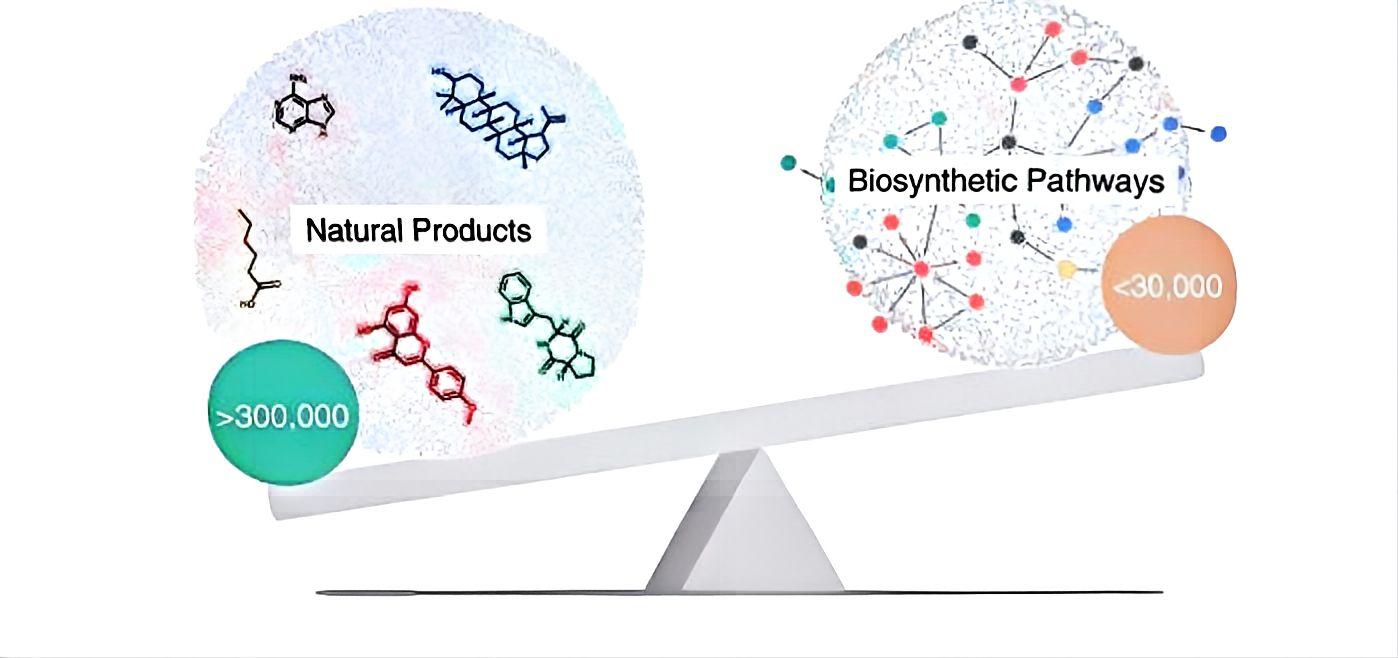
The picture is from the article:Deep learning driven biosynthetic pathways navigation for natural products with BioNavi-NP