SCS-C006120
ascomindone A
Pathway: Polyketides
Chemical Structure
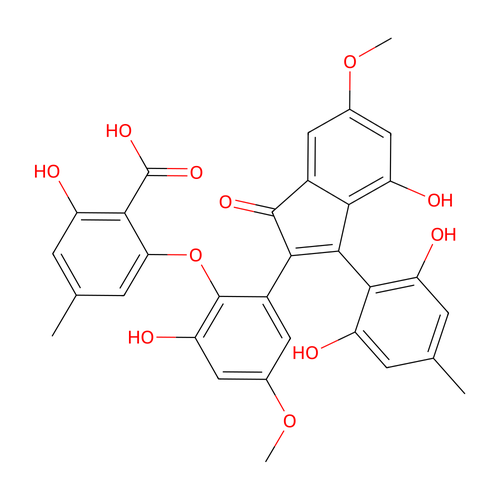
Loading 3D structure...
3D conformers are computationally generated from SMILES by RDKit for visualization and download; they are not experimental crystal or NMR structures.
Source Information
Drug-likeness (Lipinski Ro5)
Molecular Weight
586.5 Da
Threshold ≤ 500
ALogP
5.49
Threshold ≤ 5
H-Bond Donors
6
Threshold ≤ 5
H-Bond Acceptors
10
Threshold ≤ 10
3 violations (MW, ALogP, HBD) — not drug-like by Ro5
Chemical Properties
Molecular Formula:
C32H26O11
Molecular Weight:
586.5490 Da
SMILES:
COc1cc(O)c(Oc2cc(C)cc(O)c2C(=O)O)c(C2=C(c3c(O)cc(C)cc3O)c3c(O)cc(OC)cc3C2=O)c1
InChIKey:
GNUJZPJILJOQSW-UHFFFAOYSA-N
InChI:
InChI=1S/C32H26O11/c1-13-5-19(33)27(20(34)6-13)29-25-17(9-15(41-3)11-22(25)36)30(38)26(29)18-10-16(42-4)12-23(37)31(18)43-24-8-14(2)7-21(35)28(24)32(39)40/h5-12,33-37H,1-4H3,(H,39,40)
Calculated Properties
ALogP:
5.495 lipophilicity
TPSA:
183.21 Ų polar surface area
H-Bond Donors:
6
H-Bond Acceptors:
10
Rotatable Bonds:
7
Ring Count:
5
(4 aromatic)
Chiral Centers:
0
Fsp³:
0.1250 fraction sp³ carbon
Database Information
Compound ID:
SCS-C006120
NPClassifier Pathway:
Polyketides
NPClassifier Superclass:
N/A
NPClassifier Class:
N/A
Glycoside:
No
NPClassifier Status:
Classified
External Links:
General chemistry
Natural product databases
Biological Activity Data
Activity values are displayed only when a quantitative or clearly reported result is available.
Tested organisms, cell lines and molecular targets are shown under Target / model.
| Activity | Assay | Target / model | Result | Reference |
|---|---|---|---|---|
| Antioxidant | scavenging | DPPH radical | 18.1 μM | 10.1038/srep36609 Scientific Reports |
| Antioxidant | scavenging | hydroxyl radical | — Structured numeric value is not available in this record; see the primary reference. | 10.1038/srep36609 Scientific Reports |
| Antioxidant | reducing power | ferric ion | compound 1-5 also showed potent activity in FRAP assay as shown in Fig. 8 | 10.1038/srep36609 Scientific Reports |