SCS-C007590
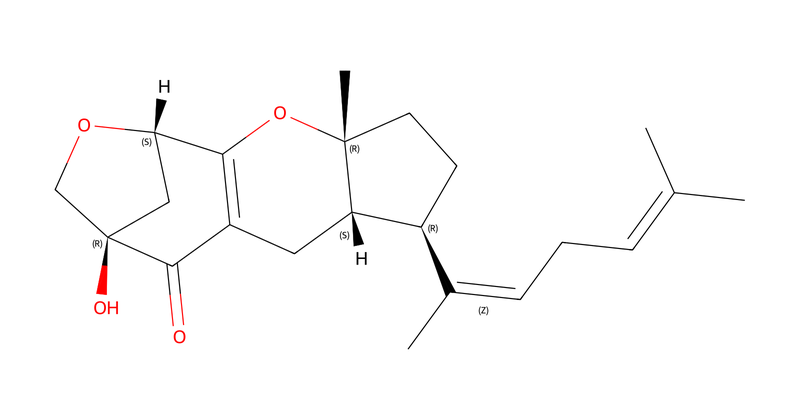
guignardone Z
Pathway: Terpenoids
Superclass: Meroterpenoids
Class: Miscellaneous meroterpenoids | Prenyl quinone meroterpenoids
Chemical Structure
Loading 3D structure...
3D conformers are computationally generated from SMILES by RDKit for visualization and download; they are not experimental crystal or NMR structures.
Source Information
Penicillium sp. NBUF154
(soft coral-derived fungus)
Kingdom
Fungi
Phylum
Ascomycota
Class
Eurotiomycetes
Order
Eurotiales
Family
Aspergillaceae
Genus
Penicillium
Species
NA
South China Sea
· 60 m
DOI:
10.1002/cbdv.202200475
· Chemistry & Biodiversity
Drug-likeness (Lipinski Ro5)
Molecular Weight
358.5 Da
Threshold ≤ 500
ALogP
3.85
Threshold ≤ 5
H-Bond Donors
1
Threshold ≤ 5
H-Bond Acceptors
4
Threshold ≤ 10
Passes Lipinski Rule of Five — drug-like candidate
Chemical Properties
Molecular Formula:
C22H30O4
Molecular Weight:
358.4780 Da
SMILES:
CC(C)=CC/C=C(/C)[C@@H]1CC[C@@]2(C)OC3=C(C[C@@H]12)C(=O)[C@]1(O)CO[C@H]3C1
InChIKey:
JZNUQSGAGXCOFE-TZPAZIFNSA-N
InChI:
InChI=1S/C22H30O4/c1-13(2)6-5-7-14(3)15-8-9-21(4)17(15)10-16-19(26-21)18-11-22(24,12-25-18)20(16)23/h6-7,15,17-18,24H,5,8-12H2,1-4H3/b14-7-/t15-,17-,18-,21+,22+/m0/s1
Calculated Properties
ALogP:
3.851 lipophilicity
TPSA:
55.76 Ų polar surface area
H-Bond Donors:
1
H-Bond Acceptors:
4
Rotatable Bonds:
3
Ring Count:
4
(0 aromatic)
Chiral Centers:
5
Fsp³:
0.6818 fraction sp³ carbon
Database Information
Compound ID:
SCS-C007590
NPClassifier Pathway:
Terpenoids
NPClassifier Superclass:
Meroterpenoids
NPClassifier Class:
Miscellaneous meroterpenoids
Prenyl quinone meroterpenoids
Glycoside:
No
NPClassifier Status:
Classified
External Links:
General chemistry
Natural product databases
Biological Activity Data
Activity values are displayed only when a quantitative or clearly reported result is available.
Tested organisms, cell lines and molecular targets are shown under Target / model.
| Activity | Assay | Target / model | Result | Reference |
|---|---|---|---|---|
| Antiviral | inhibition | human enterovirus 71 (EV71) | while other the compounds were inactive even at the highest concentrations tested (20.0 μM). | 10.1002/cbdv.202200475 Chemistry & Biodiversity |
| Antibacterial | inhibition | ten Vibrio strains (including V. parahaemolyticus NBUV004, P. damselae NBUV007, etc.) | Compounds 1–8 were found to display no inhibition against these pathogens. | 10.1002/cbdv.202200475 Chemistry & Biodiversity |